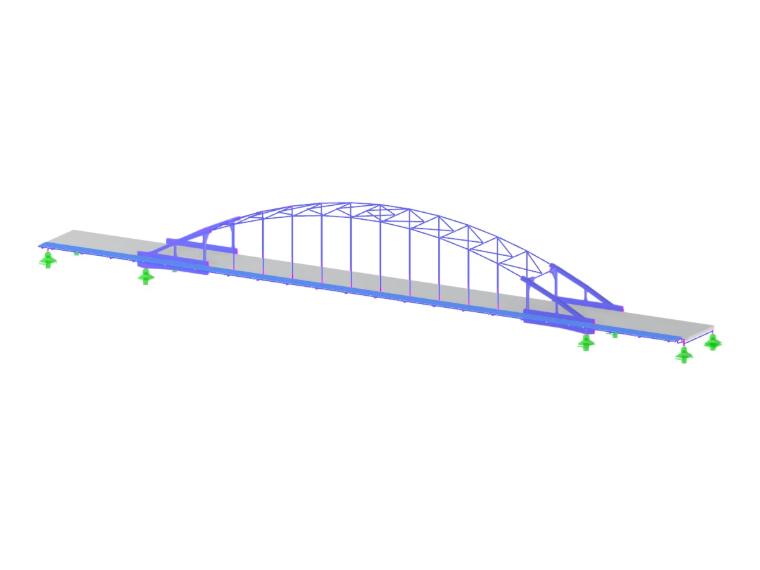
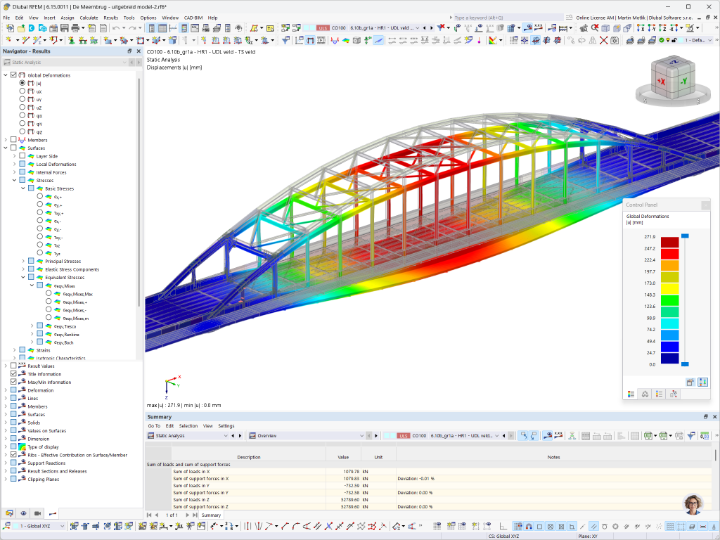
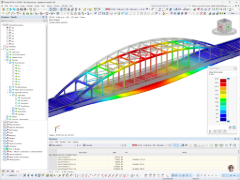
The main challenge in the modeling process was the complex geometry and behavior of the historic riveted connections. We combined a global beam model with detailed 3D submodels. Due to their particular historic built-up shape, many of the beams were modeled with RSECTION cross-sections. The torsional stiffness of some beams was modified with structural modifications to account for the behavior of regularly spaced connecting plates at the bottom flanges.
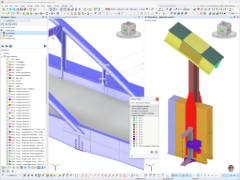
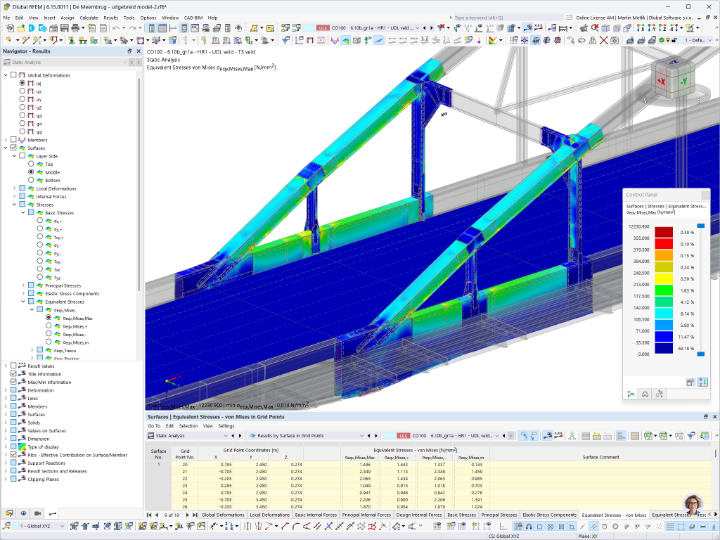
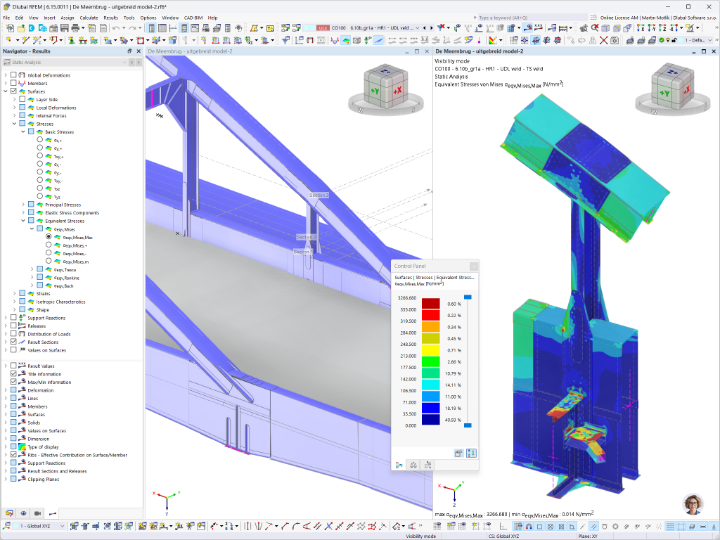
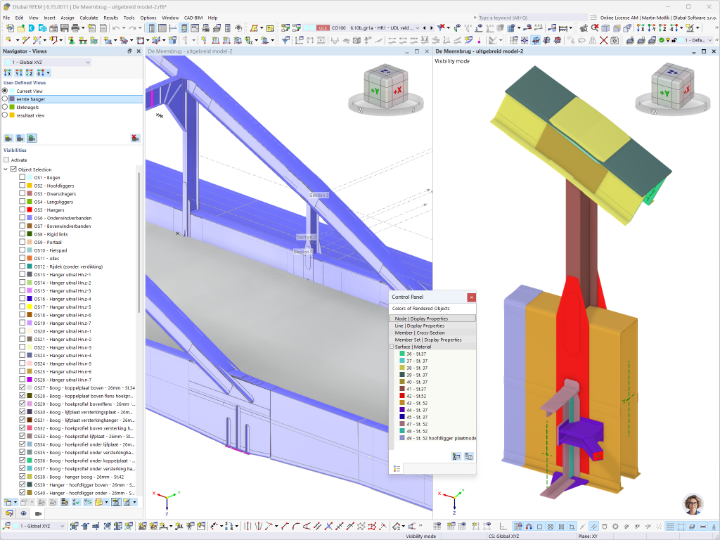
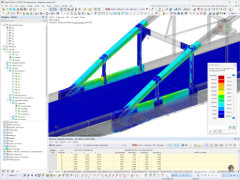
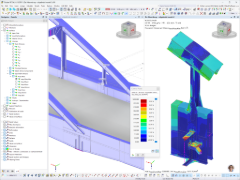
The submodels were integrated into the global model to apply realistic global forces directly to the detailed connections. The submodels were created using plate elements and rigid links to model the rivets for critical connections, including those in the portal structures and arch-tie connections.
The rivets were modeled explicitly using connecting elements with calibrated spring stiffnesses. These values were based on the spring model in prEN 1993-1-8:2021, as well as on the geometry, material properties, and number of shear planes of each rivet group. Since the submodels were placed directly in the global model, the forces on the rivets could be accurately determined in complex geometries, such as the arch-tie connection, without compromising load combinations and global behavior, as would be the case with separate submodels.
This model was used to recalculate the ultimate limit state and the fatigue limit state design of the bridge.
| Structural Analysis | Witteveen+Bos www.witteveenbos.com |
| Client | Municipality of Utrecht |
| Owner | Rijkswaterstaat |
.png?mw=720&hash=5e3db9bcf4858b336a4eac747170c58eed774556)
.png?mw=240&hash=cf3310149bd63fbad02357f3747e4165401697b7)