Introduction
Tensile membrane structures are increasingly used in modern architecture due to their lightweight nature, aesthetic appeal, and structural efficiency. However, their low mass and high flexibility make them particularly sensitive to wind loading. Traditional wind design approaches often assume isolated exposure conditions, which may lead to conservative or unrealistic predictions when the structure is located within a built-up environment. The presence of nearby buildings, canopies, landscape elements, or other obstacles modifies the incoming atmospheric boundary layer and creates shielding effects. These effects may reduce wind velocities reaching the membrane surface and consequently decrease aerodynamic pressures and structural responses. Understanding the interaction between membrane structures and their surroundings is, therefore, essential for achieving safe and economical designs [1].
Numerical Investigation
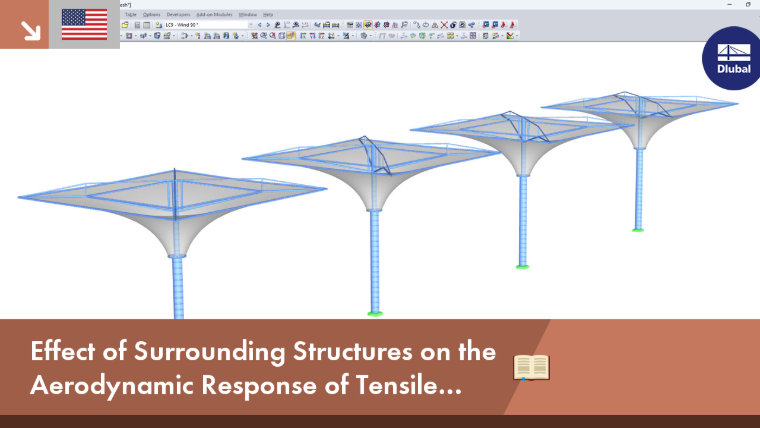
The study considers an umbrella-shaped tensile membrane canopy subjected to a wind velocity of 45 m/s (160 km/h). Four environmental configurations were analyzed:
- Case 1: Isolated membrane structure (reference case)
- Case 2: Membrane structure with neighboring shielding elements
- Case 3: Optimized surrounding configuration
- Case 4: Enhanced shielding arrangement
The CFD simulations were coupled with structural analyses to capture the interaction between aerodynamic loading and membrane deformation.
Aerodynamic Force Reduction
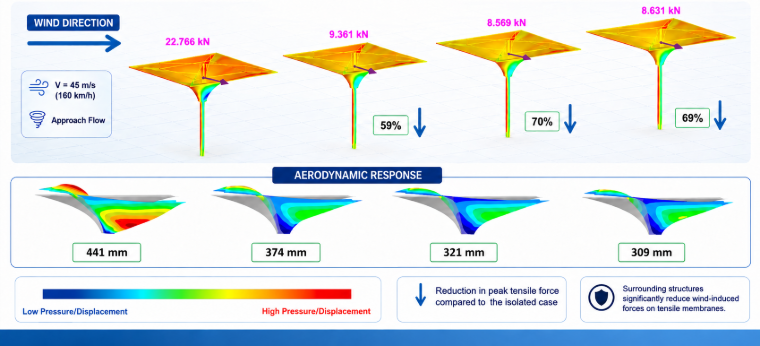
The reference isolated canopy experiences a resultant aerodynamic force of 22.766 kN. The introduction of surrounding structures significantly alters the local wind flow and reduces the load acting on the membrane. The computed aerodynamic forces are:
- Reference case: 22.766 kN
- Case 2: 9.361 kN
- Case 3: 8.569 kN
- Case 4: 8.631 kN
Compared with the isolated configuration, the surrounding structures reduced the aerodynamic force by approximately 59%, 70%, and 69%, respectively. These reductions indicate a strong shielding effect that decreases the effective wind velocity reaching the membrane surface and mitigates pressure concentrations.
Structural Response
The maximum membrane displacements obtained from the coupled analyses are:
- Reference case: 441 mm
- Case 2: 374 mm
- Case 3: 321 mm
- Case 4: 309 mm
The reduction in aerodynamic loading directly translates into improved structural performance. The optimized surrounding configurations reduce maximum displacement by approximately 15–30% compared with the isolated canopy. The displacement contours reveal a more uniform deformation pattern and lower stress concentrations in the membrane surface when shielding structures are present.
Flow Mechanisms
The observed improvements can be explained by the modification of the wind field around the membrane canopy. In the isolated case, the incoming flow impinges directly on the structure, generating large pressure differences between the windward and leeward regions. This results in significant suction zones and elevated aerodynamic forces. When surrounding structures are introduced, several beneficial aerodynamic mechanisms occur:
- Reduction of local wind speed through shielding
- Dissipation of kinetic energy before reaching the membrane
- Redistribution of pressure fields around the canopy
- Reduction of flow separation and vortex formation
- Mitigation of peak suction pressures
These mechanisms collectively contribute to lower wind loads and reduced structural deformations.
Engineering Implications
The results demonstrate that the surrounding built-up environment can play a dominant role in the wind performance of tensile membrane structures. Ignoring neighboring structures may lead to significant overestimation of wind loads and unnecessary structural conservatism. For membrane structures located in urban areas, stadium complexes, transportation hubs, or architectural campuses, detailed CFD simulations that account for the surrounding environment can provide more realistic design loads and enable substantial material savings. The findings also highlight the importance of considering aerodynamic shielding during the early stages of architectural and urban planning.
Conclusions
This investigation demonstrates the significant influence of surrounding structures on the aerodynamic response of tensile membrane canopies. The main findings can be summarized as follows:
- Neighboring structures substantially modify the local wind environment
- Aerodynamic forces were reduced by up to 70% due to shielding effects
- Maximum membrane displacements decreased by approximately 30%
- The surrounding environment can be used as an effective passive aerodynamic control strategy
- CFD-based wind engineering assessments provide valuable insights for optimizing membrane structures within complex urban environments
The study confirms that incorporating surrounding structures into wind analyses is essential for obtaining realistic aerodynamic loads and achieving efficient designs of tensile membrane systems.