The nonlinear material behavior of reinforced concrete, concrete, and steel fiber reinforced concrete can be represented using the material models "Anisotropic | Damage" and "Isotropic | Damage".
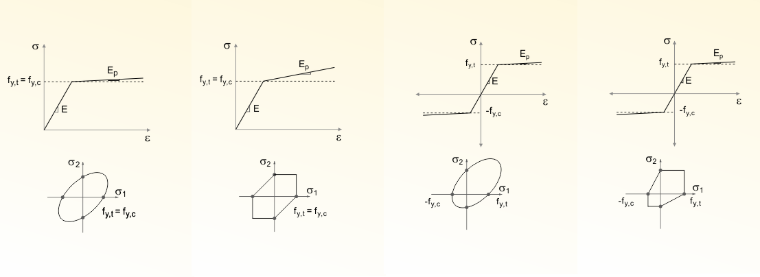
Non-antisymmetric stress-strain diagram Unlike other material models, the stress-strain diagram for the "Isotropic | Damage" and "Anisotropic | Damage" models is not antisymmetric about the origin. Thus, these models can represent the different behavior of concrete or reinforced concrete under compression and tension.
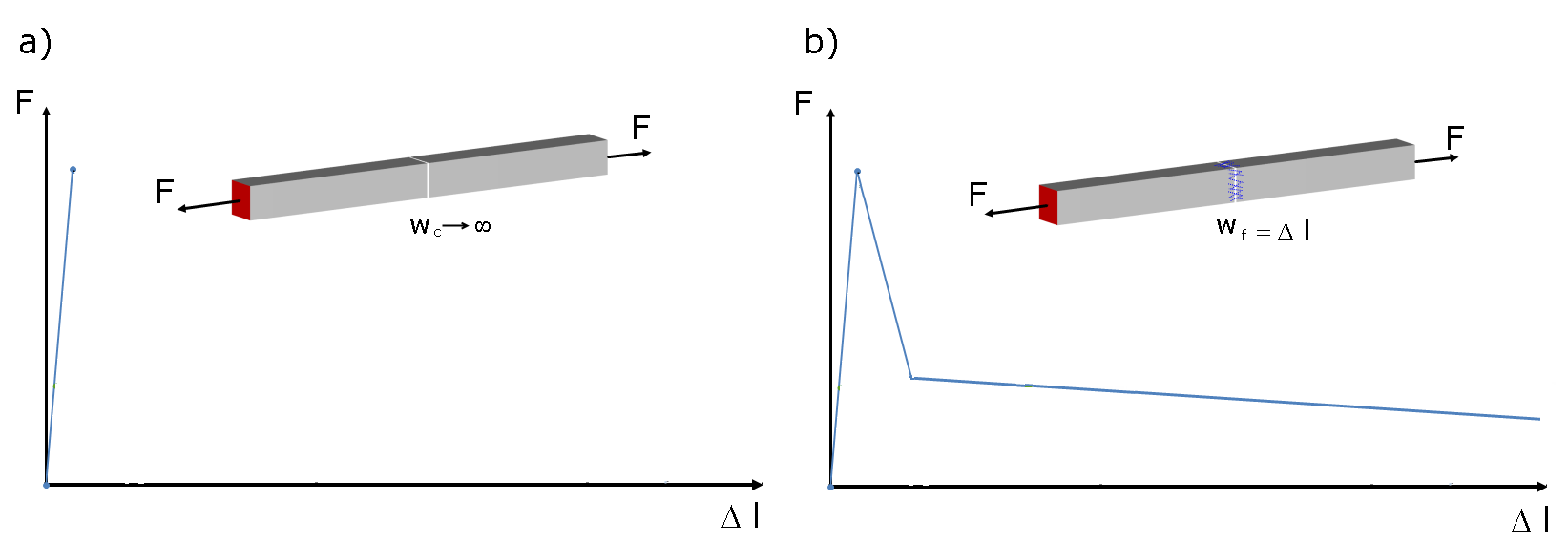
Crack formation - Smeared crack model The models can also represent the continuous degradation of the material's stiffness due to crack formation. For this purpose, a smeared crack model is applied. The image below schematically shows the options for crack modeling discretely (a) and smeared (b).
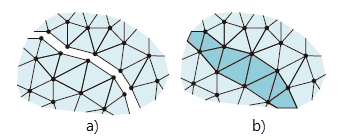
The basic idea of these models is to determine the strain state additively from a strain of the base material and a crack strain. When a crack occurs, it is assumed that the base material continues to behave elastically and that all additional strains occur in the crack. The crack is not modeled individually, but rather as so-called "smeared" damage distributed over the element.
Damage parameter The difference between the two models lies in the type of stiffness reduction.
- For the "Isotropic | Damage" material model, this is done via a scalar damage parameter.
- For the "Anisotropic | Damage" material model, the stiffness reduction is performed element-wise using a damage tensor.
Isotropic | Damage
Direction-independent degradation The isotropic damage of concrete is characterized by a direction-independent degradation of the material stiffness. The stiffness is reduced equally by a scalar damage parameter in all spatial directions, as is typical for simple continuum damage models (Mazars damage model).
The direction of the principal stresses is not taken into account; rather, the damage occurs in the direction of the equivalent strain, which also captures the third direction perpendicular to the plane. The tension zone and compression area of the stress tensor are treated separately. Different damage parameters apply in each case.
The "reference element size" controls how the strain in the crack area is scaled to the element length. With the default value of zero, no scaling takes place. As a result, the material behavior of steel fiber reinforced concrete is represented realistically.
Anisotropic | Damage
Direction-dependent degradation The anisotropic damage of concrete is characterized by a direction-dependent reduction of the material stiffness and is described using a damage tensor. This allows different stiffnesses to be represented in tension, compression, and shear directions.
Physically, the cracks act as discontinuous weak zones with a preferred orientation, whereby the normal and shear stiffnesses perpendicular or parallel to the crack plane differ significantly. Consequently, the material exhibits locally orthotropic or transversely isotropic behavior.