


Without further definition, the member elements react linearly elastically in and about all assigned degrees of freedom in an analysis. Basically, this behavior is defined by Hooke's law: In this case, the deformation u of a solid is proportional to the acting load F, or its strain Δl depends linerly on the acting force F.
In reality, however, not every element reacts linearly and elastically. For example, a slender circular member, with regard to its cross-section resistance, absorbs more tension than compression. This force-based characteristic can be captured and simulated in the numerical calculation using a member nonlinearity. In this case, due to the premature stability failure (buckling) under compression, the member strain depends nonlinearly on the acting force.
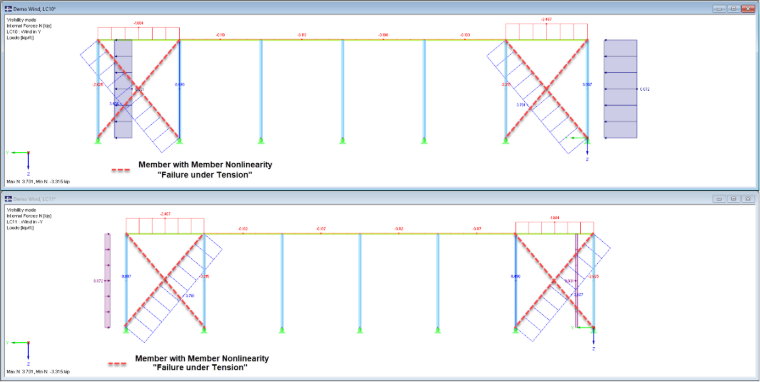
Member nonlinearities exist in various forms. In most cases, they do not depend on the quantities that are linearly related to one another, but rather on the final effect on the elements in the calculation.
Entering in RFEM and RSTAB
In RFEM and RSTAB, member nonlinearities can be entered and defined graphically using the menu "Insert" → "Model Data" → "Member Nonlinearities" → "Dialog Box", or manually using the Data Navigator or the corresponding tables.
Typical member nonlinearities are:
- Failure under tension
- Yielding when plastic resistance is reached
- Rigid as of the defined deformation u