


|
Author
|
Florian Marzec
|
The subject of this Master's thesis is a multi-criteria static and strength analysis, alongside the numerical optimization of a large-span, steel-cable roof structure.
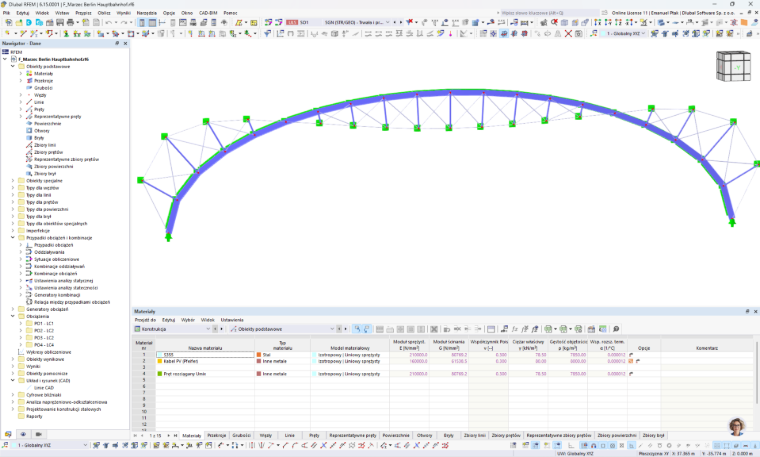
In the theoretical part, an original classification and categorization of the analyzed structures was proposed. This allowed for the systematization of knowledge and a precise shift of focus from classic Beam String Structure (BSS) systems to specific, advanced CAS (Cable Arch Structure) systems, which became the main object of further analysis. The roof structure of the Lehrter Bahnhof platforms in Berlin was adopted as a direct reference and architectural-structural inspiration.
In the design part, using a parametric design environment (Rhino/Grasshopper), a FormFinding algorithm based on the dynamic relaxation method was implemented. This allowed for the optimal shaping of the initial arch geometry of the roof girder, in strict correlation with the thrust line from dead loads, which minimized bending moments and reduced the dominant stress state to pure compression.
The main structural analysis of the CAS system was carried out in the Dlubal RFEM 6 software environment. Due to the presence of highly flexible tensile elements, the static calculations of the main frame were performed using third-order, geometrically nonlinear analysis (large deformation theory). For a comprehensive evaluation of the structure's behavior, the classic verification of the girder's stability was extended with Linear Buckling Analysis (LBA) and advanced cross-section warping analysis (7th degree of freedom). This allowed for a precise reproduction of the actual spatial flexural-torsional behavior of the analyzed arch. The obtained results were used to conduct a preliminary design of the structural elements, which is treated as a preliminary phase and foundation for the actual, full design procedure. The isolated internal force interaction diagrams and the analysis of forces in the main cable allowed for the evaluation of cross-sectional reserves and the indication of areas for further analysis. The formulated final conclusions constitute a critical summary of this preliminary design stage and define guidelines for the target design methods of CAS systems. The thesis proves that the integration of parametric Form-Finding with nonlinear FEM procedures constitutes a highly effective tool in the preliminary conceptual-design phase of modern large-span structures.