Challenge
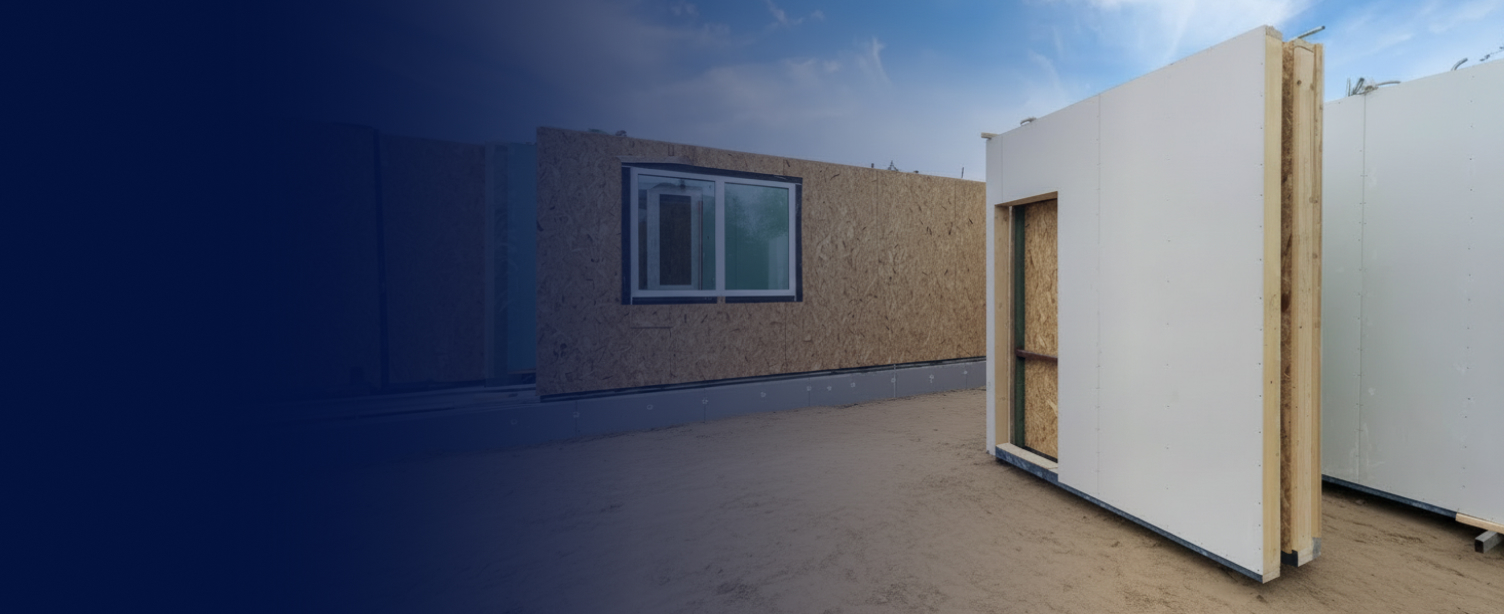
Timber panel structures are characterized by a high degree of prefabrication, short construction times, and relatively low resource consumption. However, its use has so far been concentrated primarily on low-story buildings. One challenge for multi-story timber structures is to efficiently increase the load capacity and stiffness of the stiffening walls without having to incorporate additional structural layers or fasteners.
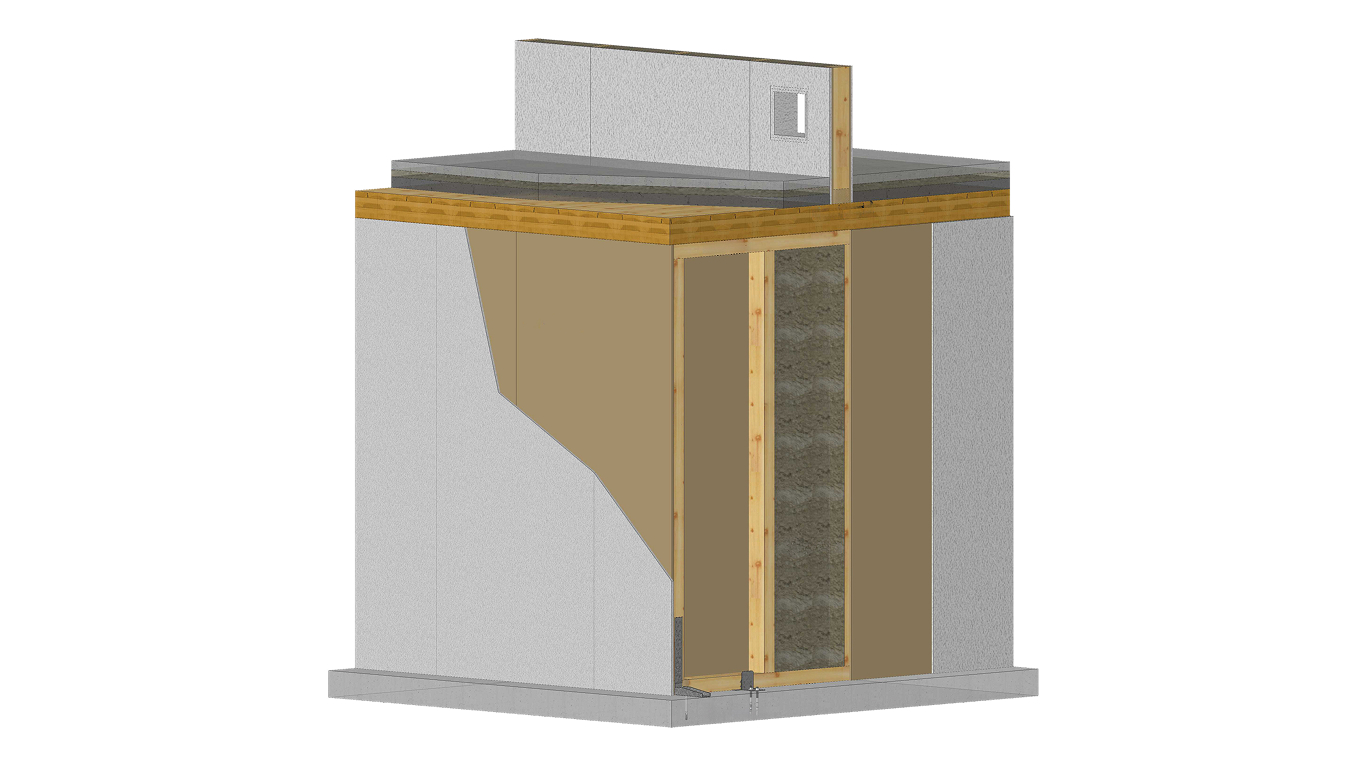
In the HELEPOLIS research project at RWTH Aachen University, researchers therefore analyzed the extent to which the fire-resistance coatings—which is required in multi-story timber structures anyway—can be used in conjunction with the structural sheathing to provide horizontal stiffening. It was necessary to model the complex interaction of timber ribs, multiple panel layers, nonlinear fasteners, and anchorages experimentally, analytically, and numerically.
Solution
A finite-element model was developed in RFEM for the numerical analyses. The timber ribs were modeled using member elements, and the sheathing and cladding layers were modeled using surface elements. The nonlinear load-deformation behavior of the fasteners between the plates and the timber frame was accounted for using line releases and continuous springs, respectively. Experimentally determined load-deformation curves from fastener tests were used as input data.
RFEM was used primarily based on the ease of defining nonlinear line releases and the automatic mesh generation. This made it possible to efficiently analyze different wall configurations and fastener arrangements and to compare the numerical results with tests on fastener assemblies, wall panels, and complete timber panel structures.
The analyses show that additional panel layers and their fasteners significantly influence the stiffness and load capacity of timber panel walls. This finding is particularly relevant to safety in seismic design and must neither be disregarded across the board nor assumed without suitable analysis models. The research results were translated into a practice-oriented design guide with a supplementary calculation tool.
Advantages of Using Dlubal Software
- Efficient nonlinear modeling — Line hinges and distributed springs directly model the behavior of connection elements based on experimental load-deformation curves
- Flexible parameter studies — Automatic mesh generation allows for the rapid analysis of various wall configurations and panel arrangements
- Validated numerical results — RFEM results have been experimentally verified in a plane of the individual fasteners, shear walls, and the entire structural system
- Application in practice — The modeling results were directly incorporated into a published design guideline for timber construction practice
- API-enabled platform — The Dlubal API allows for integration into automated structural design processes — relevant for future AI-based design tools