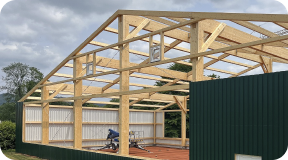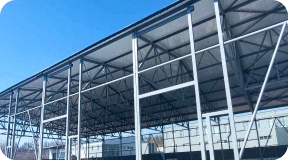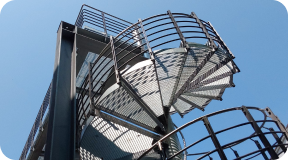
An example of metal facade structure at plan4m AG in Emmen, Lucerne.
Case Study

Precision in Building Envelope: How plan4m Optimizes Complex Facade Systems with RFEM 6

Challenge

In modern facade design, structural components, such as cantilevers and thin-walled plates, are necessary to absorb enormous loads while meeting minimalist aesthetic requirements. For the engineers at plan4m, the greatest challenge lies in performing precise calculations on these slender components. Conventional beam models often reach their limits when modeling complex stress distributions in thin plates, making it difficult to safely push the material to its load limit.

Solution

To manage this complexity, plan4m relies on RFEM 6 and, in particular, uses its powerful surface modeling capabilities to precisely analyze stress distributions. With the Nonlinear Material Behavior add-on, the team can perform design checks, ensuring that every millimeter of material is used efficiently. This shift to detailed FEA calculations guarantees that even complex element facades are implemented in a structurally safe, efficient, and manufacturing-optimized manner.

Benefits

  • Unmatched precision: Accurate analysis of thin-walled plates and complex cantilever geometries.
  • Material optimization: Significant cost savings achieved by reducing substructures without compromising safety.
  • Transparent documentation: Design checks in the style of verifiable manual calculations facilitate plausibility checks.
  • Flexibility in materials: Seamless design of steel and aluminum in an integrated environment.
Substructure Optimization of High-Rise Building Facade

For plan4m, the true strength of RFEM 6 becomes particularly evident in high-rise projects with curtain wall facades. Since these massive structures require thousands of individual components, even a small material saving per element leads to substantial overall cost reductions. RFEM 6 provides the necessary depth of analysis to dimension these substructures precisely, enabling a more slender design while fully complying with global safety standards.

The software acts as a bridge between safety and cost-effectiveness. By simulating the exact behavior of the facade frame, the team can offer clients optimized solutions that are easier to fabricate and assemble. This level of detail is particularly crucial for meeting the high wind loads and deformations encountered in high-rise buildings.

Transparency in the Workflow and Technical Validation

A standout feature in plan4m's workflow is the use of the Steel Design Add-On for detailed verifications. In contrast to "black-box" solutions, RFEM 6 provides a step-by-step breakdown of the equations and formulas. This clarity is similar to a manual structural analysis, making it significantly easier for project managers to verify results and identify potential issues at an early stage.

This transparency directly leads to greater planning reliability. When presenting designs to clients or checking authorities, the ability to provide clear and understandable stability verifications builds trust and accelerates approval processes. Structural analysis thus becomes a quality-assured, transparent process rather than a technical hurdle.

Why Dlubal Software?

  • Outstanding support: Access to a competent team that understands the craft and provides real solutions.
  • Pragmatic user interface: A clear tool that combines high-end performance with an intuitive workflow.
  • Nonlinear expertise: Add-ons such as Nonlinear Material Behavior enable state-of-the-art plastic design.
  • First-class webinars: Continuous training for beginners and professionals directly in everyday practice.